Showing posts with label #IDTAssess. Show all posts

Saturday, 28 November 2015

Distance Learning and Education

My last post on Online Presence was starting to get overly long and complex, so I decided to omit discussing Distance learning and its affect on language learning to this separate article. Such a task reminds me of the daunting task of having to narrow down my choice of topic for our assessment at the end of the year.

Online Persona

Once of the unique things about online communication is to a reasonable extent, you are free to portray whatever persona you wish - be it yourself, how you want to others to perceive you, or someone completely different to you in real life. Like being a stranger at a party, the choice is yours to be who you want to be, with changes to your height, age, profession, even perceived intelligence all possibly going undetected. You could even be God if you so wish. However, the ability to alter or distance yourself from your online persona can be a double-edged sword, as seen in this poignant video from Shaun Highton:


What's on your mind? |  Shaun Highton | 2014


But how does the ability to create an online persona and interact with others online effect learning?

Community of Inquiry

The Community of Inquiry (COI) theoretical framework, first introduced by C.S. Pierce and John Dewey, represents a process of creating a deep and meaningful (collaborative - constructivist) learning experience through the development of three independent elements - social, cognitive and teaching presence. The COI emphasises that knowledge is necessarily embedded within a social context and thus requires intersubjective agreement amoung those involved in the process od inquiry for legitimacy. (Eteokleou - Grigoriou, N. & Photiou, S., 2014:126)

In recent years, the COI model has been utilised as a 'dynamic process designed to define, describe and measure elements supporting the development of online learning communities' (Swan, K & Ice, P. 2010:1). Garrison et al (2010:88) note that 'The model of this Community of Inquiry assumes that learning occurs within the Community through the interaction of three core elements. Fig. 1 shows the three essential elements: cognitive presence, social presence, and teaching presence'.


Fig. 1 Garrison et al (2010:88) | The COI model


Garrison et al (2010:89) go on to note that 'social presence, is defined as the ability of participants in the Community of Inquiry to project their personal characteristics into the community, thereby presenting themselves to the other participants as "real people"'. The fact that your social presence in a group may be 'indirectly facilitating the process of critical thinking carried on by a community of learners' or even a 'direct contributor to the success of the educational experience' is enough to make you stand up and take notice of how you present yourself online in an educational setting.

It is easy to see how a more friendly and amicable group might find it easier to communicate together online, than a tense atmosphere of a group of strangers. I noted in my first post that our first meeting for DTLT on Adobe Connect was a little awkward, but now that we have built up a bit of a rapport and friendship with each other, we are chatting and communicating so much more freely now that we find ourselves quickly running out of time for discussion. This social interaction is particularly beneficial to language learning which is, in essence, a social activity.


Distance Learning and Education

Distance learning is a expanding rapidly, due its ease of access online and it's relatively cost effective nature, but are you receiving the same bang for your buck, so to speak? It was addressed in our tutorial that it is perhaps unfair to compare Distance Learning to traditional classroom education. Both offer different forms of learning, it is true, but the importance of Education is so great that questions constantly need to be asked of all aspects of it. Hubert Dreyfus (2001: 32) posed this question of Distance Learning:

"can distance learning enable students to acquire the skills they need in order to be good citizens skilled in various domains?"
Dreyfus believed that these skills were acquired in seven stages.

Simplification of the model - Credit: Online Reference

Novice and Advanced Beginner being the basic steps and learning through instructions and examples, Dreyfus (2001: 35) stated that  'learning, whether it takes place at a distance or face to face, can be carried out in a detached, analytical frame of mind' and thus mattered little if it was distance learning or not. In fact, I and many others frequently engage in this form of learning online. I follow instructions for recipes, watch how to correctly perform exercises at the gym, even video game tutorials follow this line of skills acquisition.

Reaching the stage of competence, where the student learns to pay less heed to all the rules, or he/she may become overwhelmed, and relies more on experience and decision-making rather than following a strict set of rules. Here, Dreyfus (2001: 39) concedes that 'the net's limitations where embodiment is concerned - the absence of face-to-face learning - may well leave students stuck at competence' Lucky for us, technology has now advanced such that this no longer applies, though I'm not entirely sure it applied to begin with. I completed an online TEFL course through e-mail, and though Dreyfus (2001:39) noted that in Distance Learning there was little  'possibility of taking the risk of proposing and defending and idea and finding out whether it fails or flies' I still had the opportunity to engage with my tutor and discuss our thoughts on Educational methodologies. Sam Harris, a well-known author once debated linguist Noam Chomsky over the ethics of war, via e-mail. I believe that if it is possible to put forth these opinions, and even though the person may be 'at home in front of his or her terminal' (2001:39), it doesn't necessarily make them immune from the risk felt and may still effect your learning on a personal level.

Dreyfus seems to have a very narrow viewpoint of what distance learning can be and I related more with Nigel Blake (2002: 379) in his retort to Dreyfus in that 'I do not find my own online practice described in this books, even in vague terms'. He too believed online learning had the 'potential for some form of extensive and serious intellectual and personal engagement, one-to-one if not face-to-face.'

Stage four is Proficiency, which Dreyfus (2001:40) notes as 'seems to develop if, and only if, experience is assimilated in this embodied, atheoretical way'. As noted in the above image, this entails being able to see "the bigger picture" and that 'the student at this level sees the problem that needs to be solved but has yet to figure out what the answer is"

In the next stage of Expertise Dreyfus (2001:41) notes that 'The expert not only sees what needs to be achieved; thanks to his vast repertoire of situational discriminations, he also sees immediately how to achieve his goal.'

Stage 6 is Mastery. As one goes up through the stages of skills acquisition, you can see the nuances and difference between them starting to lessen. It is hard to see what separates the Expert from the Master, except for here the Master must develop his own style, to go out and learn from different masters, to learn from different perspectives in order to create their own perspective.

Stage 7 - Practical Wisdom. Here Dreyfus has even abandoned his own examples of a car driver and a chess player and has dove deep into the theoretical and draws influence from the great philosopher Aristotle. Practical Wisdom as Dreyfus (2001: 48) sees it is 'the general ability to do the appropriate thing, at the appropriate time, in the appropriate way.'


While this is seen as the pinnacle of Dreyfus' stages, to me it doesn't quite fit well at the summit. Practical Wisdom seems to be more on a tangent with all the other stages, and influencing them all.


Using our Practical Wisdom - Barry Schwartz - 2010


Psychologist Barry Schwartz in his TED Talk 'Using our Practical Wisdom' , likens it to


'jazz musicians. The rules are like the notes on the page, and that gets you started, but then you dance around the notes on the page, coming up with just the right combination for this particular moment with this particular set of fellow players'

Certainly, it requires skill to pull this off, but do you really have to have mastered a skill before you can improvise and know when to do the right thing?

Conclusions:

Dreyfus' stages of skill acquisition are certainly intriguing, though I think through a narrow-minded view  of what is capable from online Education, and perhaps a bias towards spoken language, I believe he has misjudged its potential for higher level learning and critical thinking. Blake (2002: 383) again notes that 'all writing is fundamentally a social interaction' and Dreyfus should not be so quick to dismiss its qualities in respect to the emotional. Nowadays, we also have Skype, Youtube, video-conferencing and more to further interact and emphasise our presence online. With the technology we have available to us now, we have the means to enable higher-level learning online, we just need to be imaginative in the process. As stated earlier, Online Education is not the same as the traditional classroom of old. As John Maynard Keyes once put it

"The difficulty lies not in developing new ideas as in escaping from old ones"

Bibliography:
  1. Anon, Exchange with Chomsky [online] Germany: Znet, 2015 (viewed November 26th 2015) Available at: https://zcomm.org/znetarticle/exchange-with-chomsky
  2. Blake, R. (2002) Hubert Dreyfus on Distance Education: relays of educational embodiment. Educational Philosophy and Theory, 34, 4, pp.379-385 
  3. Dreyfus, H. (2001) On the Internet, 2, pp. 26-49, London: Routledge
  4. Eteokleous-Grigoriou, N. & Photiou, S (2014) Integrating Blogs in Primary Education, Research on e-Learning and ICT in Education: Technological, Pedagogical and Instructional Perspectives, 9, pp.121-137
  5. Garrison et al, (2010) Critical Inquiry in a Text-Based Environment: Computer Conferencing in Higher Education. The Internet and Higher Education, 2(2-3), pp.87-105
  6. Highton, S. What's on your Mind? [online] 2014 Available at: https://www.youtube.com/watch?v=QxVZYiJKl1Y
  7. Keyes, J.M. (1936) The General Theory of Employment, Interest and Money, United Kingdom: Palgrave MacMillan
  8. Online Reference, The five levels of skill acquisition, Novice, beginner, competent, naster and expert [online] 2015 (viewed November 26th 2015) Available at: http://blog.envole.net/the-five-levels-of-skill-acquisition-novice-beginner-competent-master-and-expert
  9. Schwartz, B.  Using our Practical Wisdom [online] New York: TED Talks, 2010 (viewed November 29th 2015) Available at: http://www.ted.com/talks/barry_schwartz_using_our_practical_wisdom?language=en
  10. Swan, K & Ice, P. (2010) The Community of Inquiry framework ten years later: introduction to the special issue. Internet and Higher Education, 13(1-2), 1-4



Tuesday, 3 November 2015

The Role of the Teacher - Revisited

In one of my first posts, I made an attempt to deconstruct what it means to be a teacher in today's modern society where people have access to (almost) unlimited information at the click of a mouse. In it, I perhaps didn't do full justice to the role of the teacher and over-simplified it too much. While it was my intention to break it down to its very basics, I think I may have lost a certain nuance in just how critical a role the teacher plays in the learning process.


How teachers perceive themselves according to Beijaard (2000:756)

Last week's talks of VLE's and PLE's drew many parallels with my original musings of the role of the teacher. In PLE's especially, the pedagogy and learning distances itself from the teacher and becomes the responsibility of the student to seek out the information he/she needs. The teacher's role as such comprises much of the same three key elements I had outlined.


  1. Provide guidance and assistance. A facilitator, acting as a grounding point for the student's PLE, the teacher offers them a safe haven if they are having difficulties and also as a guide to keep them on the right path in their discovery of knowledge and not to stray too far off topic.
  2. Accelerating the process - the teacher kick starts the PLE by showing them how to set up their PLE, where to source their information from and how to differentiate between facts and opinions.
  3. Ensure people's safety. Again this may mean literal safety but also in a more broader sense it is the duty of the teacher to ensure that the student has the necessary means to succeed in their PLE and are not setting them up for a fall, so to speak. It can be a daunting task taking over the responsibility of being in control of your own learning and the teacher needs to motivate and encourage the students to believe in themselves and their abilities.

However, it went much deeper than this. It was clear to see from the articles and videos about PLE's that the teacher plays a crucial role in the success of the PLE for the student. Drexler (2010: 382) noted this:

"A student's success depended on his or her motivation but also greatly on the strategic guidance of the teacher"

Drexler (2010: 370) also saw the teacher as a facilitator of the student's needs, quoting  Mostschnig-Pitrik & Holzinger (2002: 166) in that the teacher "supports the students in their search and supply of relevant material, coordinates the students' presentations of individual milestones of their projects, moderates discussions, consults in all kinds of problem-solving and seeking for solutions, lectures on topics that are selected in plenary discussions with the students and conforms to the curriculum"


The various roles of a teacher in a student's PLE according to Wendy Drexler

In order to connect with the networked student and guide them in their PLE's, today's modern teacher must become 'networked' as well.  As stated in my previous post, this new outlook and approach to teaching made me reflect upon my own PLE and see how my own learning is structured. Am I a networked teacher capable of guiding students to create and follow their own PLE's? Can I offer the same help and support to students as outlined by Drexler? What areas do I need to work on? I have never truly created and utilised a PLE to further my learning. Perhaps I will start from there. As Drexler (2010: 370) put it "A teacher is better equipped to facilitate networked learning if he or she has experienced the construction of such a model first hand."


Bibliography:
  1. Beijaard D., Verloop, N. & Vermunt, J. (2000) Teachers' perceptions of professional identity: an exploratory study from a personal knowledge perspective. Teacher and Teaching Education. 16. pp. 749-764
  2. Drexler, W. (2010) The networked student model for construction of personal learning environments: Balancing teacher control and student autonomy. Australasian Journal of Educational Technology, 26. 3. pp. 369-385

Wednesday, 28 October 2015

The Digital Native Debate

The Digital Native v Digital Immigrant debate created when Prensky first coined the phrases has certainly ignited serious discussion over the years and perhaps this was his intention. That so many were enamored by his proposal without much evidence to the fact was brought up in our discussions. Such buzzwords are wont to do, with people actively searching for words to define whole groups or even generations of people such as Generation X, the Baby Boomers and so on. In fact, my first thought upon reading it was a scene from The Simpsons where TV executives are just using a series of buzzwords to make their point, rather than saying anything of substance.

Credit: 20th Century Fox


That this was my initial reaction to Prenksy's thoughts shows I wasn't overly enamoured with his preachings. And it did seem like preaching at times

"school often feels pretty much as if we've brought in a population of heavily accented, unintelligible foreigners to lecture them."
(Prensky: 2001: 2)
Natives vs Immigrants

Part of what irked me was that Prensky wrote as if we Digital Immigrants were somehow inferior to Digital Natives. I'm sure Bill Gates or Larry Page would take issue with being called an 'unintelligible foreigner' with regards to technology. Prenksy and articles agreeing with his analogy tended to take a stance that all counters to their argument were invalid and retorted with in a way akin to a petulant teenager 'You just don't understand!'

As Bayne & Ross (2011:162) put it

"Any critique of technology, its role in education, or its implementation, as long as it comes from an 'immigrant', can be quickly compartmentalised as belonging to a marginalised, illegitimate voice."
Over-simplification

Another thing I disliked about his Digital Native and Digital Immigrant analogy was that it was far too black and white. You're either a Native or an Immigrant. There was no grey area in between. In his conclusion (Prenksy 2001: 6), he urges Digital Immigrants to change their ways and that it's

"high time for them to stop their grousing, and as the Nike motto of the Digital Native generation says, “Just do it!”


I wonder if Prensky was aware that the Nike 'Just Do It' campaign launched in 1988. Again, I saw this as another way to gleam over the harsher realities and make his idea more appealing.

I also found myself again more inclined to agree with Bayne & Ross (2011:160), who were in turn quoting Kerri Lee Krause:

"experiences and understandings of technology vary significantly according to socio-economic background, age and gender - the 'assumption of homogeneity is misleading and dangerous' she concludes(2007:138)" 
Analogy, not truth

My final complaint with Prensky's writings was that it drew parallels with areas of language learning and made tenuous comparisons with them to fit into his Digital Native ideology, passing them off as truths, when in fact they were ungrounded and simply constructs of his own making. Just because something fits in a metaphor, doesn't mean it is true in the real world.

"Smart adult immigrants accept that they don't know about their new world and take advantage of their kids to help them learn and integrate."
I would assume smart adult immigrants would try to assimilate into the culture themselves, and not through their children, but remember in Prensky's world this is an impossibility. While I can see the idea he is trying to put across, where the children are immersed in a new language or culture and have an advantage over their predecessors in this sense.  Sure, little Johnny could help his grandma set up an twitter account, but Granny could also learn it from her friends, a teacher or maybe look it up herself online. Also, as stated before, this greatly depends on various factors on Jonny's ability to help at all. If Granny doesn't have previous access to a computer, perhaps neither does Jonny.


Discussion, I think, is the essence of Prensky's idea. He set up this analogy in order to stir controversy and spark debate among the Educational community and it was not all doom and gloom. I did agree with many of the points he made and the overall idea he put forward that Digital Natives learn differently is very intriguing. In fact, I found Prensky's follow up From Digital Natives and Digital Immigrants to Digital Wisdom a lot more palatable.

"Technology alone will not replace intuition, good judgement, problem-solving abilities, and a clear moral compass"
                                                   (Prensky: 2009:1)

Digital Wisdom

In fact, I found the concept of digital wisdom pretty fascinating and how simple everyday things that I have taken for granted through the use of technology has freed our minds to concentrate on the larger picture, while the computer takes care of the more mundane tasks. Prenksy's so-called Wisdom Enhancement allows us many advantages as he (Prensky: 2009: 3) outlined as such:

• We make decisions based on only a portion of the available data.
• We make assumptions, often inaccurate, about the thoughts or intentions of others.
• We depend on educated guessing and verification (the traditional scientific method) to find new
answers.
• We are limited in our ability to predict the future and construct what-if scenarios.
• We cannot deal well with complexity beyond a certain point.
• We cannot see, hear, touch, feel, or smell beyond the range of our senses.
• We find it difficult to hold multiple perspectives simultaneously.
• We have difficulty separating emotional responses from rational conclusions.
• We forget.

The last example really struck a chord with me. Something so simple as forgetting a birthday or even what date it is, can often make me feel foolish, but a computer never forgets and the simple act of a Facebook reminder to wish someone a happy birthday, or a quick check on my smartphone to jot todays date on a form, spares me this foolishness.

However, the simple act of checking my phone for a birthday doesn't make me wise. It's the fact that I no longer need to waste my cognitive effort in remembering the date and can concentrate on other areas, such as thinking about what present to buy, who to invite etc., that allows my wisdom to flow. The number crunching power of computers have allowed mathematicians to theorise permutations involving enormous figures that would be physically impossible to do by hand in a lifetime.

"scientists no longer have to make educated guesses, construct hypotheses and models, and test them with data-based experiments and examples. Instead, they can mine the complete set of data for patterns that reveal effects, producing scientific conclusions without further experimentation"
(Prensky:2009: 4)


As I said in my previous post, I am a big fan of fantasy football, and I saw many similarities between it and the world of Digital Wisdom. The sheer wealth of data available to fantasy managers to draw conclusions about players is truly staggering. Simon March, last years winner of Fantasy Football, confessed that he didn't watch many games at all last season, and made most of his decisions based off of stats.

"There obviously are advantages to watching matches, though, but not being able to can force you to think about players differently and, perhaps, in terms closer to how FPL is scored. And adopting that mindset can definitely work to your favour"

Conclusion 

Whether Prensky was right or not to segregate humanity into Digital Natives and Digital Immigrants ultimately is not the question that needs answering. Technology is an ever-growing presence in our lives, and even more so, in the lives of the younger generations. As ever, how we adapt our teaching to suit the needs of the learner is central to our progression in education. What needs to be done to create a more suitable education system for the Digital Native or Digitally Wise? I have noticed that Week 6, the next week of our course deals with Virtual Learning Environments (VLE) and Personal Learning Environments (PLE). Could these be a true benefit to the youth of today or simply pandering to the 'buzzword' of a generation? Or is it simply a case where the the teacher has one more area of integration to work with in the classroom?

Bibliography;

  1. Bayne, S. & Ross, J.  (2011) 'Digital Natives' and 'Digital Immigrants' Discourses. A Critique. In R. Land and S. Bayne (Eds.), Digital Difference: Perspectives on Online Learning. 2011. Sense Publishers. pp. 159-169
  2. FANTASY FOOTBALL SCOUT, Interview - Simon March - Fantasy Premier League Winner [online]. London: Fantasy football Scout, 2015. [viewed 13 November 2015]. Available from: http://www.fantasyfootballscout.co.uk/2015/05/29/interview-simon-march-fantasy-premier-league-winner/
  3. Prensky, M. (2001) Digital native, digital immigrants. On immigrants. On the Horizon 9, 5. MCB University Press 
  4. Prensky, (2009) M. H.Sapiens Digital: From Digital Immigrants and Digital Natives to Digital Wisdom. Innovate Online. 

Tuesday, 20 October 2015

The Role of the Teacher

There was a lot of talk about the role of the teacher in regards to SLA and technology in this week's readings and in the online tutorial. I found myself pressing further back to its very essence. In its basic form, just what is a teacher?

Douwe Beijaard (Beijaard et al, 2000: 751) stated that

 'teachers derive their professional identity from (most combinations of) the ways they see themselves as subject matter experts, pedagogical experts, and didactical experts.'


However, what if you were to remove any of these aspects? Has technology made these elements redundant? In our online tutorial, it was mentioned how Adelaide University had cancelled all lecture-style classes and replaced them with online video-lectures.

"If students can get the material online, they are not going to come to lectures"
                                                (Warren Bebington, vice-chancellor University of Adelaide)

I am, for the most part, self-taught in Korean, and though I am nowhere near fluent, I would say that my Korean is passable. In fact, I would nearly go so far as to say that anything can be self-taught if given enough time and opportunities. Consider a Groundhog Day-like situation. Having an infinite time to study and practice by himself, Bill Murray's character becomes adept in ice-sculpting, playing the piano and reciting French poetry.


Now this of course is a fictional occurrence, but the question still stands. Are time, money, and, in some regards, human ethics the only true factors hindering a person's learning? Give a man an endless supply of bodies, could he successfully remove an appendix? Trial and error would suggest he could, though it would leave a lot of cadavers in the morgue.

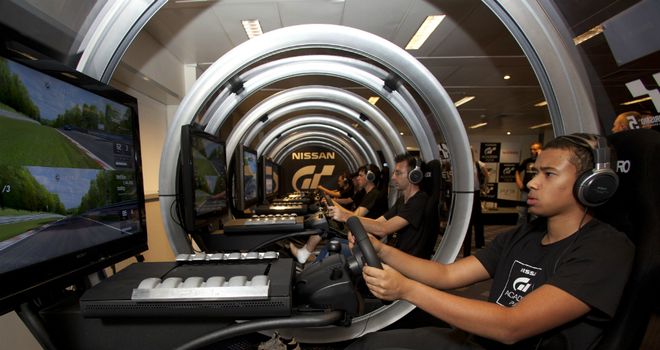
But what if you take away the unrealistic notion of countless bodies piling up and replaced it with a realistic simulation, giving the person countless attempts to succeed? Could a man learn to land a Boeing jet simply by using a flight simulator? In 2008, Polyphony Digital, creators of the Gran Turismo racing games, teamed up with Sony and Nissan to create GT Academy, a competition within the Gran Turismo games that gives winners a chance to become real racing drivers. The 2011 winner, Jann Mardenborough, is now a single-seater racecar driver for Redbull. 


"Interestingly, Mardenborough's video game experience means that he benefits more from simulator work than even some seasoned professionals do. Some pro racing drivers struggle to benefit from sim racing because they are so used to practicing in the real car."
                                                                  (Joseph Barron, Gamestop, 2014)

This seems a fitting example of the Digital Native v Digital Immigrant as posed by Prensky (Prensky, 2001: 2) in that the previous generation just can't adjust to the modern methodologies and tech.

 'There are hundreds of examples of the digital immigrant accent. They include printing out your email (or having your secretary print it out for you – an even “thicker” accent); needing to print out a document written on the computer in order to edit it (rather than just editing on the screen); and bringing people physically into your office to see an interesting web site (rather than just sending them the URL).'

However, it must be noted that in all these examples, these people didn't do it all alone. Currently, I am seeing a Korean tutor to improve my speaking skills. Jann Mardenborough required an instructor for his transition from gamer to racecar driver and even Bill Murray had a piano tutor. At some point, a teacher was necessary to:

1) Provide guidance and assistance
2) Accelerate the process
3) Ensure peoples safety

1) Provide guidance and assistance

Almost every Educational Theorist has now distanced themselves from the 'chalk-and'talk' style autocratic teacher of yesteryear. Beijaard stated that  'Teaching is much more than the transition of Knowledge' and that 'Teaching cannot be reduced to a technical or instrumental action that results in learning gains with students' (Beijaard et al, 2000: 751). Classes are now more focused on intrinsic learning, with the students front and centre, discovering information and knowledge, creating ideas for themselves, with the teacher acting as a facilitator to their needs.

2) Accelerating the process

Quite simply, at times it is a lot easier to be shown what to do than to figure it out for yourself. Perhaps the whole process is intricate or complex, or perhaps you just don't have the time to waste. If I'm paying for guitar lessons, then I'd rather be told where the D chord is than to spend the whole lesson trying to figure it out myself.

Now, this could be seen as a form of guidance, and a good teacher will generally know when to let the students figure it out for themselves and when to step in. However, sometimes, such as the case with Jann Mardenborough, where a lot of time and money was on the line, they simply couldn't just guide him through the process.

3) Ensure peoples safety

Safety isn't just about physical harm. It's easy to see how a driving instructor keeps you safe during a driving lesson, or a carpenter showing his apprentice how to use a lathe, but what about in a less hands-on classroom? In my last post I mentioned how social anxiety is a hindrance to language acquisition. As such, so too is it the responsibility of the teacher to ensure a safe nurturing environment for his/her students.

Conclusion:

Of course, this is quite a large simplification of the role of the teacher and words such as guidance and nurturing were skimmed over lightly, but make no mistake, these are huge roles to fill in a person's education. It was merely an attempt by me to deconstruct the idea of a teacher and view it fundamentally.

So what does this all mean? Another Doomsday prediction of the end of teachers? Not at all. Just simply another viewpoint highlighting the necessity for teachers to distance themselves from the 'chalk-and-talk' and step into the role that the students need them to provide. In this Digital Age where information is abundant and you can play computer games that teach you physics and how to build and land a space shuttle, the teacher needs to refine his/her role in the students learning. I am reminded again of our core reading this week of Blake's 'A Brave New Digital Classroom' in which he puts forward the notion that 'teachers who use technology will probably replace those who do not' (Blake, 2008: 30) or as David Thornburg more bluntly put it
"Any teacher that can be replaced by a computer, deserves to be."

Bibliography:

  1. BARRON, J., Meet the Gran Turismo player now driving race cars for real [online]. San Francisco: GameStop, 2014. [viewed 18 November 2015] Available from: http://www.gamespot.com/articles/meet-the-gran-turismo-player-now-driving-race-cars-for-real/1100-6419397/
  2. Blake, R. (2008) Brave new digital classroom: technology and foreign language learning. Washington, D.C.: Georgetown University Press, [electronic resource].
  3. Beijaard D., Verloop, N. & Vermunt, J. (2000) Teachers' perceptions of professional identity: an exploratory study from a personal knowledge perspective. Teacher and Teaching Education. 16. pp. 749-764
  4. DODD, T., University of Adelaide is phasing out lectures [online]. Sydney: Australian Financial News, 2015. [viewed 13 November 2015] Available from: http://www.afr.com/technology/apps/education/university-of-adelaide-is-phasing-out-lectures-20150625-ghxgozPrensky, M. Digital native, digital immigrants. On immigrants. On the Horizon 9.2001. 5. MCB University Press